
 简体中文
简体中文

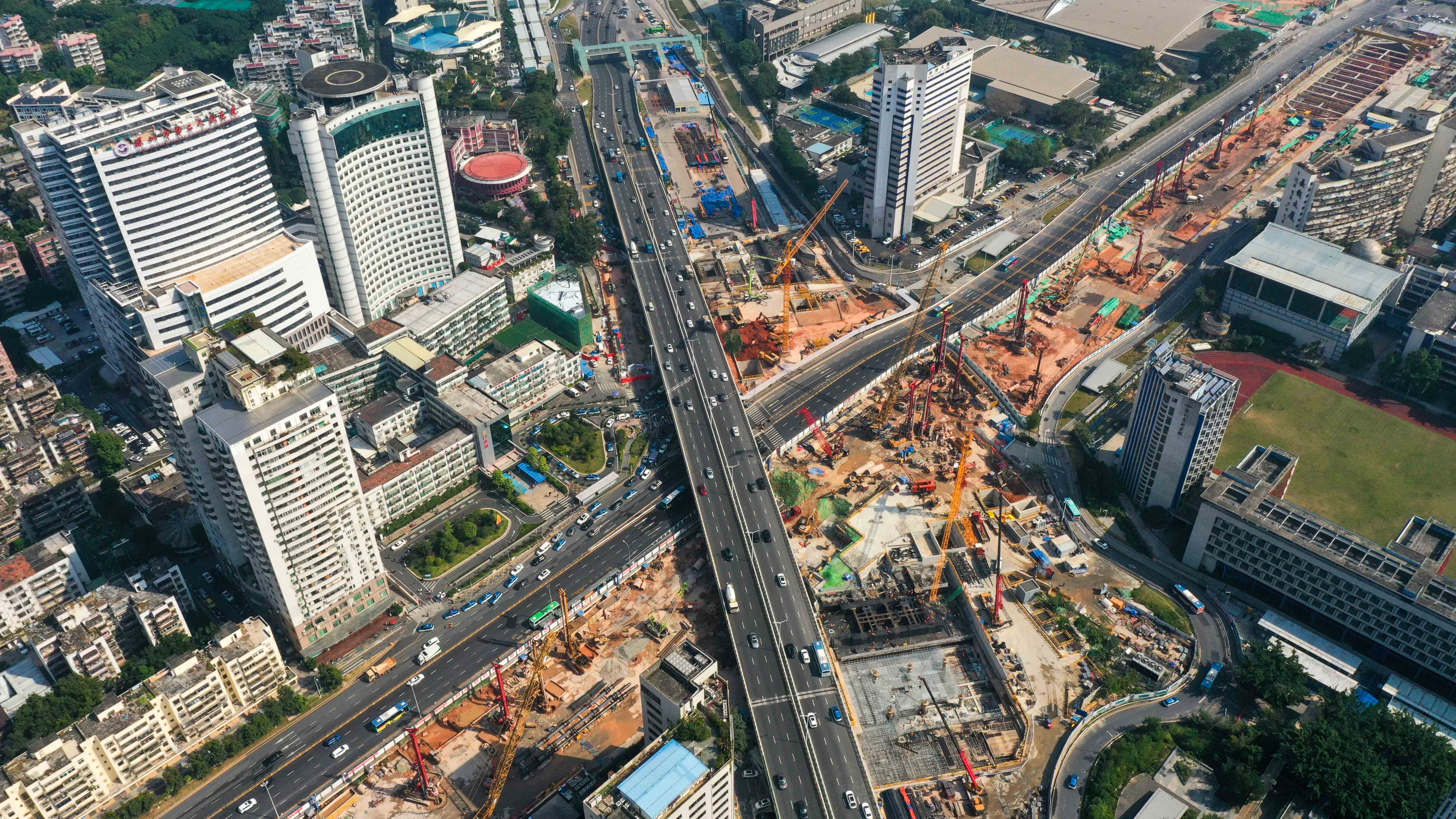
Huangmugang Integrated Transportation Hub is located at the core of the five-way intersection in Futian Central District, Shenzhen. As a "station-city integration" project integrating three-line subway transfer, "one bridge and one tunnel" municipal transportation, and underground commerce, it covers a total construction area of 194,000 square meters with a planned total investment of 8.278 billion yuan (total investment estimate of approximately 6.998 billion yuan). The project is undertaken by China Railway Group Limited as the joint venture general contractor, with China Railway Southern taking the lead in construction management and China Railway No.1 Engineering Bureau, No.4 Engineering Bureau, and Tunnel Bureau responsible for the specific construction. Due to multiple factors such as site constraints, technical complexity, environmental conditions, and foundation engineering, its construction has become a typical representative of key and difficult projects in the industry.
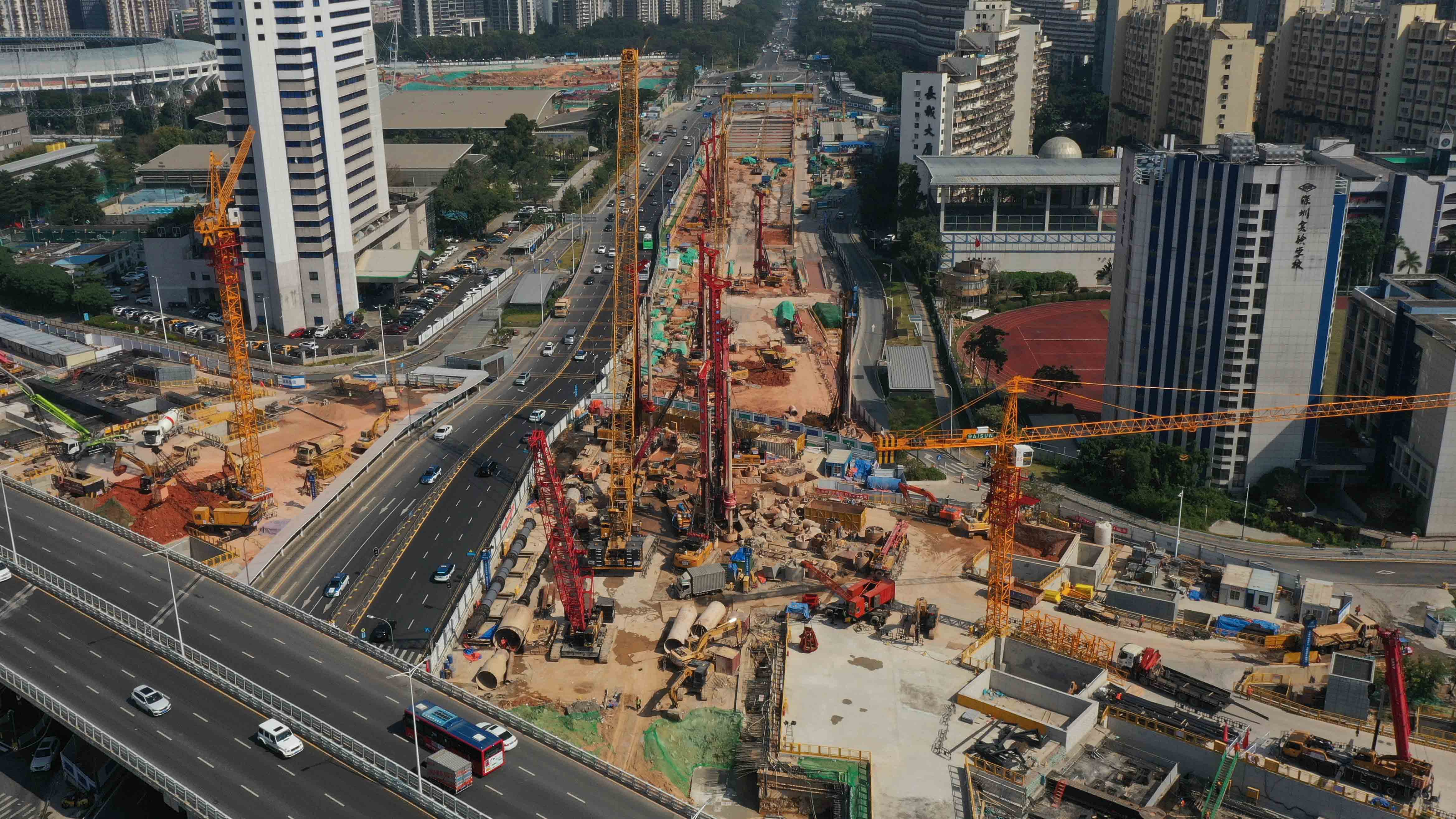
I. Core Construction Difficulties
Limited construction site and complex environment: The project is situated in the urban core area, adjacent to dense business formats such as Shenzhen No.2 People's Hospital and Huaqiangbei Commercial Street. The five-way intersection bears a huge traffic volume, and the construction site is only limited to the scope of the original overpass, resulting in extremely tight space and high difficulty in material transportation and construction surface expansion.
High risk of existing line reconstruction: As the largest-scale existing line reconstruction project in China, it requires underground floor addition and through reconstruction without affecting the normal operation of Metro Line 7. Frequent structural system conversion demands precise control of settlement and vibration during construction to avoid impacts on the existing line.
Arduous traffic diversion pressure: The original 4-story overpass (with a total length of 1,544 meters and a weight of 42,000 tons) needs to be demolished. Additionally, there are dense surrounding pipelines (including important ones such as 110kV/220kV power pipes and ϕ1000mm sewage pipes), coupled with heavy tasks of greening relocation, land acquisition and house demolition. Coordination involves multiple departments and ownership units, leading to prominent conflicts between construction and traffic flow.
High difficulty in technical integration: The project involves multi-professional cross-construction including subway, bridge, tunnel, and underground space. In particular, the construction of China's first large-span steel box arch bridge integrating station and bridge—with a 125-meter main span steel box girder basket arch directly supported on the roof of the underground station—imposes stringent requirements on structural stress and installation accuracy.
Prominent challenges in foundation construction: The site stratum is mainly composed of gravelly cohesive soil and weathered granite, containing Quaternary pore water and bedrock fissure water (slightly confined), making groundwater treatment complex. The ultra-deep, ultra-wide and irregular foundation pit has an excavation depth of 14 meters, adjacent to the existing station and steel temporary bridge, requiring the maximum horizontal displacement to be controlled within 10mm, which poses great difficulty in deformation prevention and control. Diaphragm wall construction under low headroom conditions requires a composite system of steel columns and section steel beams; the "V"-shaped column hybrid structure has high positioning accuracy requirements, and the replacement of the support system involves significant risks.
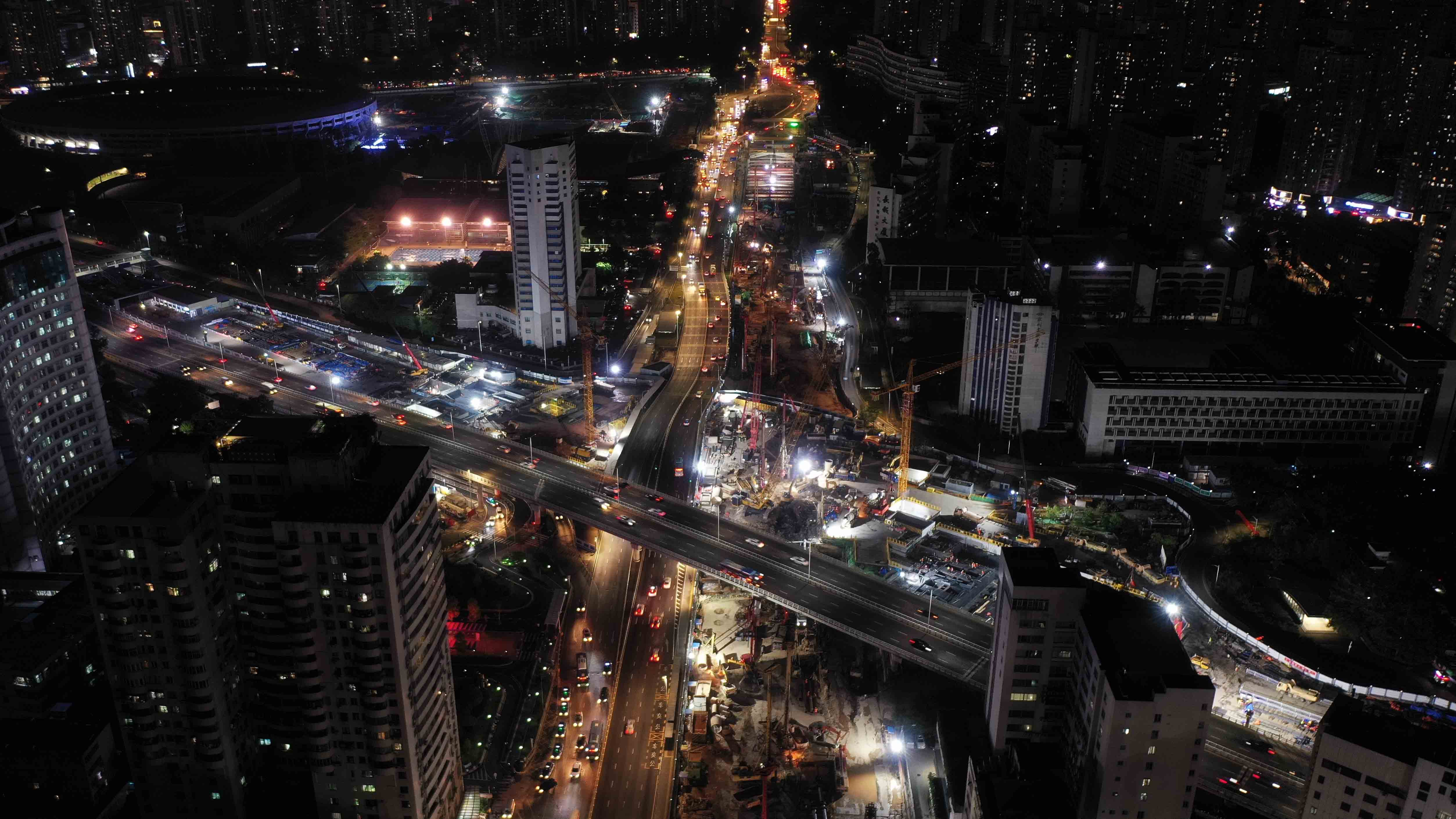
Record-breaking rapid demolition: Adopting the scheme of "Spring Festival road closure + non-destructive cutting + multi-method combination", the project completed the demolition of the over 10,000-ton overpass in only 9 days through three methods including modular vehicle supporting, cutting and transporting, and full framing hoisting, setting a "new Shenzhen speed" and minimizing the impact on citizens' travel.
Innovative technologies to solve problems: BIM technology is applied for construction simulation and collision avoidance; innovative technologies such as ground unloading and underground reinforcement, and the "support first, then reconstruct" active underpinning system are adopted to ensure the safe operation of the existing line. Prefabricated tooling technology is promoted in bridge construction, and matching, cutting and rechecking of steel box arch ribs are carried out in advance to guarantee installation accuracy.
Efficient three-dimensional construction organization: The "overall package bidding" model is adopted to integrate multi-professional construction, addressing the pain points of many interfaces and large coordination volume. In the construction of the four underground floors, the subway transfer layer, commercial layer, tunnel and bridge foundation projects are advanced synchronously, realizing seamless cross-connection of various processes.
Strict green and safety control: The traditional demolition process with high vibration and high dust is abandoned; modular cutting and low-noise construction equipment are used throughout the process, strictly controlling the noise standard of 70dB during the day and 55dB at night. A 24-hour on-site command center is set up during construction to ensure the smooth flow of "life channels" and the safety of surrounding people's livelihood.